
INTRODUCTION:
Poly(lactic-co-glycolic acid) (PLGA) is a biodegradable synthetic copolymer comprising of repeating units of lactic acid and glycolic acid. It is widely used in pharmaceutical and biomedical fields due to its excellent biocompatibility and ability to degrade into non-toxic metabolites. Unlike non-degradable polymers, PLGA undergoes controlled hydrolysis in the body, making it ideal for sustained drug delivery and resorbable medical devices. Aliphatic polyester copolymer (lactide:glycolide ratios such as 50:50, 65:35, 75:25). Hydrolytically degradable into lactic acid and glycolic acid. Typically supplied as white to off-white solid (powder, pellets, or granules).
|
Primary CAS no. |
26780-50-7 Commonly used for general, random copolymers of lactide and glycolide used in FDA-approved drug delivery and tissue engineering. |
|---|---|
|
Specific CAS no. |
34346-01-5, Frequently used for Poly(DL-lactic acid-co-glycolic acid) acid-terminated copolymers |
|
Structure |
It is synthesized via ring-opening co-polymerization of glycolide and lactide. |
|
Applications |
It is widely used in microspheres, surgical sutures, and drug delivery systems. |
|
Structure |
|
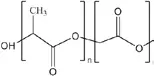
MANUFACTURE:
Typically manufactured by ring-opening copolymerization of lactide & glycolide monomers under controlled conditions using catalysts (e.g., tin-based catalyst), allowing precise control over molecular weight and copolymer composition.
APPLICATION:
Pharmaceutical
- Controlled drug delivery systems (microspheres, nanoparticles, depot injections)
- Long-acting injectable formulations (e.g., sustained-release therapeutics)
- Implantable drug delivery devices
- Vaccine delivery systems (adjuvant/carrier matrix)
Medical devices
- Resorbable sutures and surgical meshes
- Orthopedic fixation devices (pins, screws, plates)
- Tissue engineering scaffolds
- Wound healing materials
It is widely used in biomedical systems because it:
- provides controlled and sustained drug release
- degrades into biocompatible, metabolizable products
- eliminates need for surgical removal (bioabsorbable)
- allows tunable degradation kinetics based on composition
Veterinary
- Long-acting injectable formulations for animal health
- Biodegradable implants for sustained drug delivery
Cosmetic / personal-care
- Used in advanced dermal delivery systems (encapsulation of actives)
- Explored in biodegradable microcarrier systems for skincare formulations
SPECIFICATIONS:
|
Test |
Unit |
Specification |
|---|---|---|
|
Appearance |
- |
White to off-white solid (powder, granules, or pellets) |
|
Identification |
a) By IR or NMR |
The infrared absorption/NMR spectrum of the test sample should be concordant with the reference spectrum of PLGA |
|
b) By inherent viscosity / GPC |
Molecular weight distribution consistent with specification |
|
|
Lactide:Glycolide Ratio |
mol % |
As specified (e.g., 50:50, 65:35, 75:25) |
|
Inherent Viscosity |
dL/g |
Typically 0.2 – 1.0 (grade dependent) |
|
Residual Monomers |
% |
NMT 0.5 |
|
Moisture Content |
% |
NMT 5.0 |
|
Residual Solvents |
ppm |
Complies with ICH limits |
|
Glass Transition Temperature (Tg) |
°C |
Typically 40 – 60 (grade dependent) |
PACKING:
HDPE containers / fiber drums with inner polyethylene liner
STORAGE:
Store in tightly sealed containers in a cool, dry place (2–8 °C recommended). Protect from moisture and prolonged exposure to heat to prevent hydrolytic degradation.and contamination.
COMMERCIAL NOTE:
PLGA is available in multiple grades with tailored molecular weight and lactide:glycolide ratios to meet specific drug delivery and biomedical requirements. Custom specifications, technical data, and SDS can be provided upon request.
ICS offers Poly(lactic-co-glycolic acid) (PLGA) on commercial scales and welcomes enquiries. No matter the quantity you need, our exceptional quality & services will make ICS your supplier of choice. For additional information or Safety Data Sheet (SDS), please contact us at- info@itsusainc.com or Phone# 713-337-0152.


